
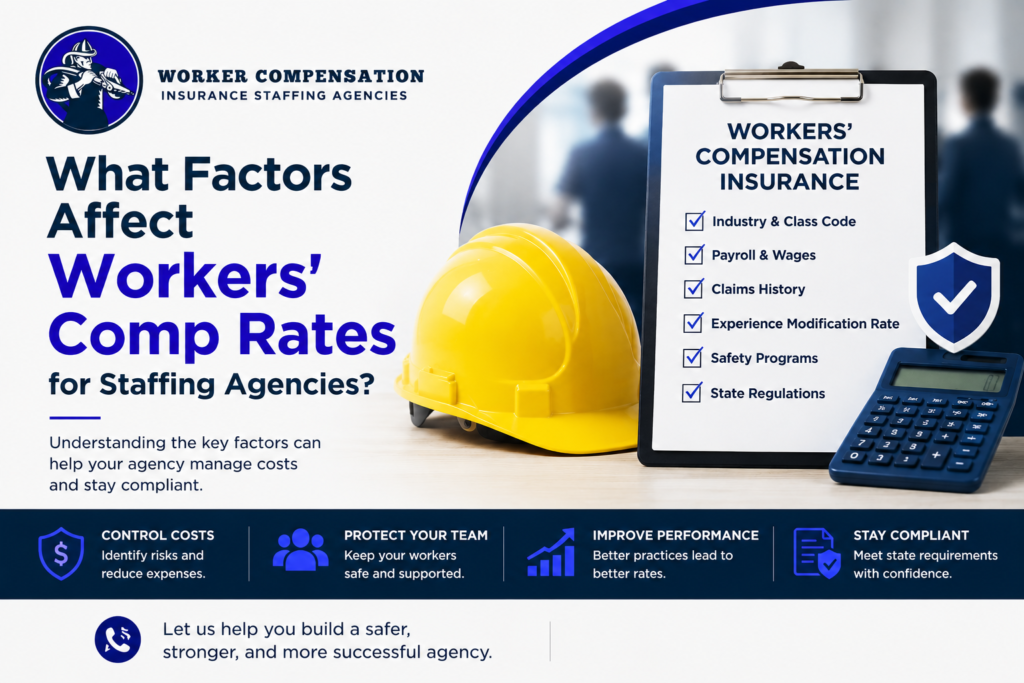
Workers’ compensation insurance is often one of the largest single expenses for staffing agencies. Unlike traditional businesses with a stable workforce in a controlled environment, staffing agencies operate as employers of record while their employees work across dozens of client companies, industries, and states. This complex exposure makes understanding workers’ comp rates essential—not just for budgeting, but for survival in a competitive industry.
If you’re running a staffing agency, you’ve likely noticed that your workers’ comp premiums can vary significantly from year to year. Here’s what drives those costs and how you can take control of them.
The Core Factors That Determine Your Workers’ Comp Rates
- Employee Classification Codes: Getting This Wrong Is Costly
The most fundamental factor affecting your workers’ comp rates is how your placed employees are classified. Each job type has a specific four-digit classification code that carries a different risk level and corresponding premium rate. For example, clerical staffing might cost $0.30–$1.00 per $100 of payroll, while industrial or construction staffing can exceed $5.00 per $100.
Here’s what many staffing agency owners get wrong: workers’ comp codes are based on the client’s core business activity, not the employee’s job title. A forklift driver placed at a manufacturing plant falls under the manufacturing classification, not a generic “driver” code. Misclassification is one of the most common and expensive errors in staffing workers’ comp programs. Without detailed job-specific records, auditors may assign workers to the highest-rated applicable classification—inflating your premium without reflecting actual risk.
Some states have special classification systems for temporary staffing. Washington State, for instance, uses 19 specific risk classes that apply only to temporary staffing companies, with codes starting with “7”. Pennsylvania uses a 3-digit system with a leading “2”. Knowing these nuances is critical.
- The Experience Modification Factor (EMR/Mod)
If there’s one number that staffing agency owners should obsess over, it’s the Experience Modification Rate (EMR), also called the “mod.” This is a multiplier applied directly to your base premium. A mod of 1.00 means you’re paying the industry average. A mod of 0.90 means a 10% discount. A mod of 1.20 means you’re paying a 20% surcharge.
Consider this: if your base premium is $100,000 and your mod is 1.20, you’re paying $120,000—$20,000 more than you should. A 0.10 reduction in your mod can produce significant premium savings.
The mod is calculated using a rolling three-year window of your claims history. The formula divides claims into primary losses (the first $18,500 of each claim) and excess losses (anything above that). Here’s the important part: frequency of small claims hurts your mod more than one large catastrophic claim. Multiple minor injuries will drive your mod up faster than a single serious incident.
- Payroll Volume
Workers’ comp premiums are calculated per $100 of payroll. Higher payroll means higher premiums, but the rate applied varies dramatically based on risk. A staffing agency with $5 million in payroll in a low-risk clerical classification will pay much less than an agency with the same payroll placing construction workers.
Accurate payroll reporting is essential for maintaining appropriate premium levels. Inaccurate reporting can lead to premium adjustments and audit surprises.
- Claims History and Frequency
Insurers view frequent claims as a sign of poor safety culture or inadequate training. For staffing agencies, claims management is uniquely challenging because you don’t control the client work environments where injuries occur. This means you’re exposed to risks that other employers can directly manage.
High turnover compounds this problem. New employees are statistically more likely to experience accidents during their first few weeks—they may not be fully trained, familiar with safety procedures, or comfortable with the workflow. If your agency has high turnover, you’re constantly cycling inexperienced workers into potentially hazardous environments, which insurers recognize and price accordingly.
- Geographic Location
Where you operate matters. State laws, claim trends, and local insurance market conditions all impact pricing. Some states have their own workers’ comp rating bureaus (like California’s WCIRB), while others use NCCI. Monopolistic states like Washington, Ohio, North Dakota, and Wyoming require staffing agencies to purchase workers’ comp directly from the state government.
Urban locations with higher workplace density may experience elevated rates due to the increased likelihood.
- Client Risk Profile
Here’s a strategy many staffing agencies overlook: you may be able to use your client’s experience modifier instead of your own. When placing employees with licensed contractors who have a lower EMR than your agency, you might qualify to use their mod for premium calculations. This can result in significant savings but requires careful documentation and approval.
Hidden Risks and Red Flags
Be wary of staffing agencies offering ultra-low markups—they’re often cutting corners on workers’ comp coverage. It’s not uncommon for these agencies to miscategorize class codes to save money, which is illegal and puts both the agency and host employers at risk. When selecting your own workers’ comp coverage, “cheap” policies often come with:
- Higher claim denial rates
- Limited coverage with many exclusions
- Poor claims support
- Financial instability of the insurer
- These hidden costs can far outweigh any initial premium savings.
How to Reduce Your Workers’ Comp Costs
- Verify Class Code Accuracy
Conduct a thorough review of your class codes against actual placement activity at each renewal. Prepare justification documentation for any restricted codes before submission.
- Manage Open Claims
Open claims with inflated reserves can drive your mod in the wrong direction for three years. Work with your carrier’s claims team to push for timely claim closure and challenge inflated reserves.
- Implement Return-to-Work Programs
Structured return-to-work programs reduce claim duration and lower indemnity payouts. For staffing firms, modified-duty placements must be arranged with client companies—document these policies and ensure client service agreements support modified-duty accommodation where possible.
- Submit Clean Underwriting Packages
Incomplete applications delay quotes and weaken negotiating leverage. A complete submission includes :
- ACORD application
- Supplemental questionnaire
- Five years of currently valued loss runs
- Five years of payroll and premium history
- Current experience rating worksheet
- Written explanations for claims exceeding $25,000
- Work with a Specialist Broker
Many staffing owners work with generalist brokers who don’t review the mod until renewal. A specialist will proactively review your mod worksheet annually and help you identify errors and savings opportunities.
Conclusion
Workers’ compensation for staffing agencies isn’t a once-a-year transaction—it’s an ongoing practice that requires attention to classification accuracy, claims management, and mod monitoring. The agencies that treat it as a year-round priority are the ones that control costs, maintain competitive markups, and build sustainable businesses.
Your workers’ comp rates reflect your risk profile. The more you can demonstrate control over safety, accurate classification, and claims management, the better your rates will be.
FAQs
Why are workers' comp rates higher for staffing agencies than for direct-hire employers?
Staffing agencies face higher rates because they assume risk without direct control over the workplace. Unlike a manufacturer that can enforce safety protocols on its own floor, staffing agencies place workers into unfamiliar environments with different hazards, equipment, and safety cultures.
How often are workers' comp premiums audited for staffing agencies?
Most staffing agencies undergo a premium audit annually, typically 60–90 days after policy expiration. During the audit, the carrier reviews actual payroll records and class code allocations against what was estimated during policy issuance.
Can a staffing agency use its clients' workers' comp rates?
In some cases, yes. Many carriers allow staffing agencies to apply the client’s experience modification factor when placing employees with that client, provided the client has a lower mod than the agency.
What is the difference between NCCI and independent state rating bureaus?
While manual rates and the e-mod formula are not negotiable, you can influence your final premium through several avenues. Carriers may offer credits or discounts for robust safety programs, drug-free workplace initiatives, or significant payroll growth.
How does employee turnover impact workers' comp premiums?
High turnover significantly increases your premiums because new workers are 2–3 times more likely to suffer workplace injuries during their first 30–90 days of employment.