
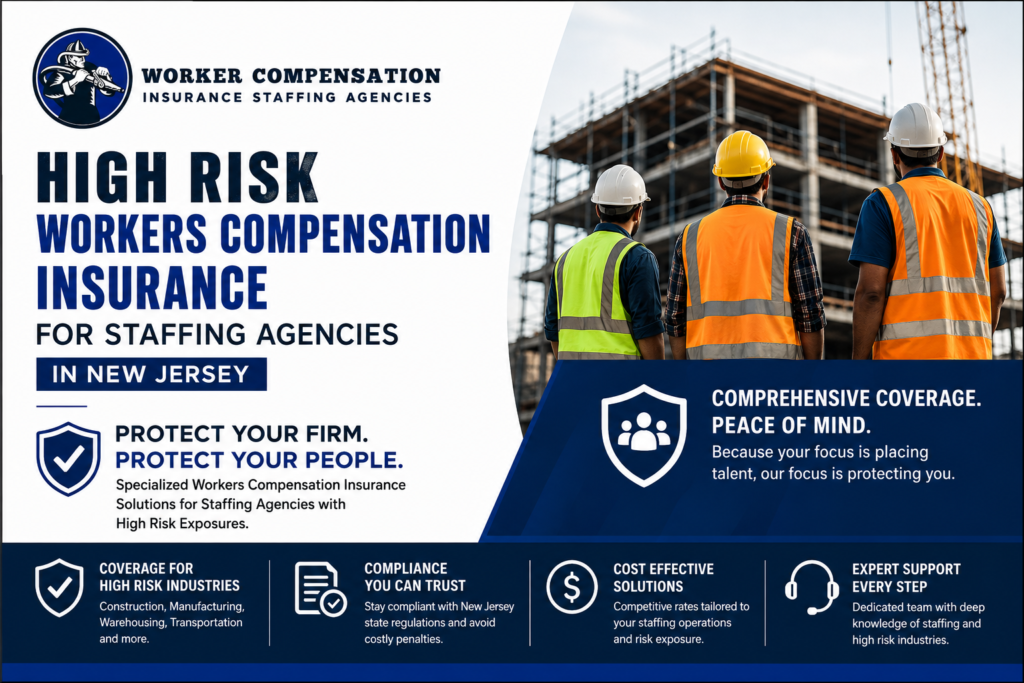
New Jersey’s staffing industry is a powerhouse. From the industrial docks of Newark to the construction sites in Cherry Hill, temporary employees keep the Garden State’s economy moving. However, placing workers in physically demanding roles comes with a unique financial exposure. For agency owners, securing High Risk Workers Compensation Insurance for Staffing Agencies in New Jersey isn’t just a legal checkbox—it’s the lifeline that keeps your business solvent after a workplace injury.
If you’ve been searching for High Risk Workers Compensation Insurance for Staffing Agencies near me, you already know that standard carriers often reject applications involving forklift operators, roofers, or warehouse laborers. This guide explains why high-risk coverage is different and how to secure it without breaking your budget.
Why Standard Workers’ Comp Fails Staffing Agencies
Most insurance carriers evaluate risk based on a single employer with a consistent workforce. Staffing agencies flip this model upside down. You send temporary workers into unfamiliar environments every day. The host company controls the site safety, but you—the staffing agency—are typically responsible for the workers’ comp claim.
When you place employees in “high-risk” categories (Class Codes 0005, 0002, 0004 for construction or 0012 for manufacturing), carriers see:
- Lack of control over daily safety protocols.
- Higher frequency of sprains, falls, and machinery accidents.
- Experience modifiers that can skyrocket after just one claim.
That is precisely why specialized High Risk Workers Compensation Insurance for Staffing Agencies in New Jersey exists. These policies are designed to absorb the volatility of temporary labor while keeping your premiums predictable.
What Qualifies as “High Risk” in New Jersey?
Not every temp role needs specialty coverage. However, if your agency supplies workers for any of the following sectors, you need a high-risk policy immediately:
- Construction & Roofing (e.g., scaffolding, demolition)
- Logistics & Warehousing (heavy lifting, forklift operation)
- Manufacturing (press operators, assembly line machinery)
- Environmental Remediation (exposure to chemicals or biohazards)
- Snow Removal & Landscaping (seasonal spikes in slip-and-falls)
Without proper coverage, a single $200,000 claim for a torn rotator cuff or a crushed digit could shutter your agency. When you search for High Risk Workers Compensation Insurance for Staffing Agencies near me, you need a provider who understands New Jersey’s specific legal landscape—including the state’s strict “no-fault” workers’ comp system.
The New Jersey Factor: Laws & Penalties
New Jersey is notoriously rigorous on workers’ compensation compliance. The NJ Division of Workers’ Compensation mandates that any business with employees (including temporary staff) must carry coverage. Failure to provide workers compensation insurance staffing agencies rely on results in:
- Stop-work orders from the state.
- Fines of up to $5,000 for every 10 days without coverage.
- Personal liability for agency owners (yes, they can go after your personal assets).
Moreover, temporary workers in NJ have the right to file claims against both the staffing agency and the host company. If your policy is not explicitly rated for high-risk classes, the carrier may deny the claim, leaving you to pay medical bills and lost wages out of pocket.
How to Lower Your Premiums Despite High Risk
Many agency owners assume that “high risk” means unaffordable. That is a myth. With the right strategy, you can manage costs while maintaining robust protection.
- Implement a “Safety-First” Vetting Process
Carriers love data. Show them that you conduct pre-hire physical capability tests and site-specific safety orientations. Some workers compensation insurance staffing agencies providers offer discounts of 5-15% for documented safety protocols.
- Use Pay-as-You-Go Policies
Traditional workers’ comp requires large upfront deposits. For high-risk staffing, look for “pay-as-you-go” plans where premiums adjust based on actual payroll each week. This prevents year-end audits from blindsiding you with massive additional bills.
- Bundle with General Liability
Many carriers offering High Risk Workers Compensation Insurance for Staffing Agencies in New Jersey will reduce your total premium if you purchase General Liability and/or Employment Practices Liability Insurance (EPLI) from the same provider.
Finding “High Risk Workers Compensation Insurance for Staffing Agencies near me” – The Right Way
If you have Googled that phrase, you have probably seen dozens of national aggregators who quote standard policies that get declined upon underwriting review. Here is what to look for in a local specialist:
NJ-Domiciled Carriers: Some regional insurers (like NJM Insurance Group or selective programs through Berkley) understand the Jersey market better than national giants.
Experience with PEO Co-Employment: The best partners know how to structure policies that clearly delineate responsibility between your agency and the host employer.
Fast Certificate Issuance: Your clients will demand proof of coverage before a temp starts. Your insurer must issue certificates within hours, not days.
Pro Tip: When you meet with a broker, bring your last 12 months of payroll by class code. The more granular your data, the more accurately they can shop for workers compensation insurance staffing agencies carriers that specialize in your exact mix of risks.
The Cost of Waiting: A Real-World Scenario
Let’s look at a typical New Jersey staffing agency placing 15 light-industrial workers and 5 roofers. The owner decides to “save money” by classifying all 20 workers under a low-risk clerical code.
- The event: A roofer falls off a ladder, breaking his leg and requiring surgery.
- The claim cost: $87,000 in medical bills + $24,000 in lost wages = $111,000.
- The investigation: The carrier audits payroll, discovers the misclassification, and denies the claim entirely.
- The result: The agency pays $111,000 out of pocket plus $18,000 in state fines.
Conversely, the same agency with proper High Risk Workers Compensation Insurance for Staffing Agencies in New Jersey would pay a deductible of $1,000 (or less) and retain full coverage.
Conclusion
Your staffing agency can thrive in New Jersey’s competitive landscape—even while placing workers in dangerous jobs. The key is accepting that high-risk exposure requires specialized insurance, not avoidance. By partnering with an experienced broker who actively shops for High Risk Workers Compensation Insurance for Staffing Agencies near me, you turn a potential liability into a competitive advantage. Clients will trust you more because they know you carry legitimate, class-code accurate coverage.
Stop gambling with misclassifications and state penalties. Secure a workers compensation insurance staffing agencies policy tailored to the unique volatility of temp labor today. Your future self—and your temporary workforce—will thank you.
FAQs
Can I use a PEO to avoid high-risk workers’ comp?
No. A PEO (Professional Employer Organization) provides coverage, but they still rate your employees based on actual job duties. High-risk class codes apply even under a PEO model.
How quickly can I get a quote?
Specialized brokers focused on High Risk Workers Compensation Insurance for Staffing Agencies in New Jersey can deliver indicative quotes within 24-48 hours, provided you supply accurate payroll estimates.
What if my agency only has one high-risk employee?
That one employee still dictates your classification. You must carry the proper class code for that role, even if the rest of your staff are clerical.
What happens if one of my temporary workers gets injured at a client's worksite? Who is responsible—me or the client?
This is the million-dollar question for every agency owner. In New Jersey, the staffing agency is almost always considered the “employer of record” for workers’ compensation purposes. That means the financial responsibility for the claim falls on your policy, not the client’s.
My agency places workers in both high-risk and low-risk roles. Can I split my policy to save money?
Yes, absolutely. This is where the expertise of a specialized broker pays off. Workers’ compensation policies use classification codes (Class Codes) that separate employees by job duties.