
For staffing agencies, few operational challenges rival the complexity of managing workers’ compensation insurance. Between fluctuating payrolls, diverse job classifications, and multi-state compliance requirements, traditional workers’ comp policies often feel like they were designed for a different kind of business entirely.
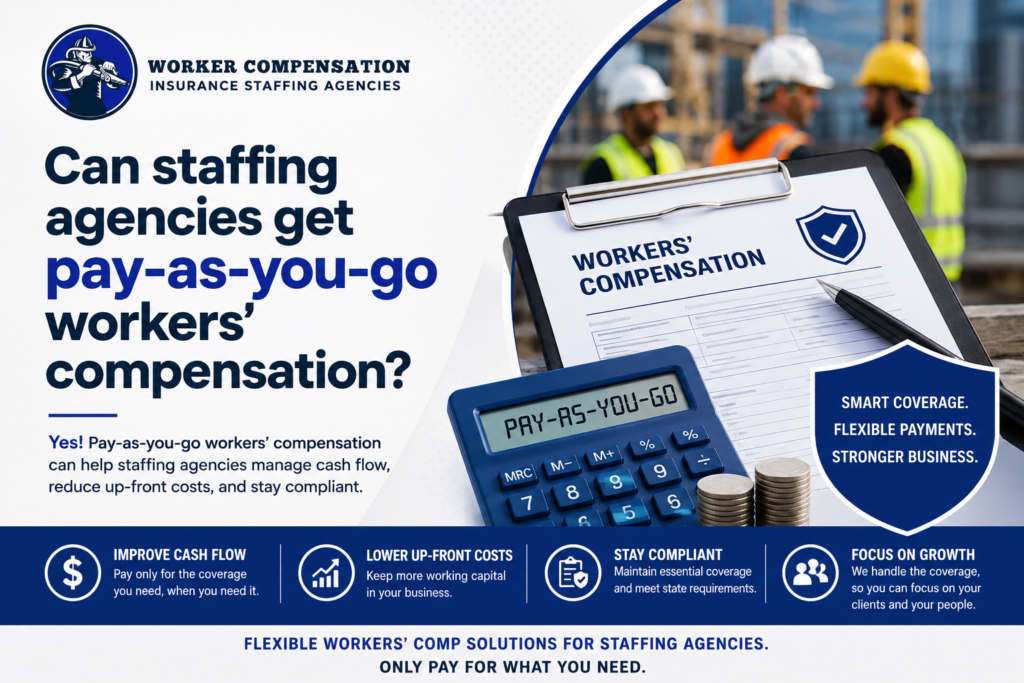
Enter pay-as-you-go workers’ compensation—a payment model that’s gaining significant traction in the staffing industry. But can staffing agencies actually get this type of coverage? The short answer is yes. Here’s everything you need to know about how it works, why it matters, and how to secure it for your agency.
What Is Pay-As-You-Go Workers’ Compensation?
Pay-as-you-go workers’ compensation is a flexible premium payment model where your insurance costs are calculated based on actual payroll data rather than estimated annual figures. Here’s how it works in practice:
- Instead of paying a large upfront deposit (often tens of thousands of dollars), you pay premiums each pay period based on the exact number of employees you have on assignment.
- When your workforce expands for a new client contract, your premium automatically adjusts upward.
- When assignments end or seasonal slowdowns occur, your payments decrease proportionally.
This stands in stark contrast to traditional workers’ comp policies, which require agencies to estimate annual payroll upfront—often leading to surprise audit bills or overpayment that ties up cash flow for months.
Why Staffing Agencies Need This Payment Model
Staffing agencies operate in a world of constant fluctuation. Temporary workers come and go. Client demands a shift. Payrolls expand and contract weekly. Traditional insurance models, with their fixed annual estimates and large deposits, simply weren’t built for this level of volatility. Pay-as-you-go addresses several pain points unique to staffing firms:
- Cash Flow Management
Staffing agencies already carry the burden of weekly payroll for dozens or hundreds of employees. Adding a massive upfront insurance deposit on top of that can create serious financial strain. Pay-as-you-go eliminates this barrier by allowing agencies to pay only as they report payroll.
- Eliminates Costly Audits
Traditional policies require end-of-year audits to reconcile estimates with actual payroll figures. If you underestimate, you face a surprise bill. If you overestimate, you wait months for a refund. Pay-as-you-go policies tie premiums directly to real-time payroll data, eliminating these audit surprises.
- Accurate Risk Alignment
Because premiums are based on the actual work being performed at any given time, your coverage more accurately reflects your current risk exposure. This is especially valuable for agencies that place workers across multiple industries with vastly different risk profiles.
Are All Staffing Agencies Eligible?
While pay-as-you-go is increasingly available, not every agency qualifies for every program. Several factors influence eligibility:
Industry classification is a primary consideration. Agencies placing workers in low-risk clerical or professional roles typically have more options than those serving high-risk manufacturing or construction sectors. However, specialized carriers now offer pay-as-you-go programs designed specifically for industrial staffing firms as well.
Claims history matters significantly. Agencies with a history of frequent or severe claims may face higher rates or limited options. This is why implementing robust safety programs and accurate job classification is essential.
Minimum Premium Requirements vary by carrier. Some programs target larger agencies with annual premiums of $25,000 or more, while others work with smaller firms.
Finding the Right Provider
When shopping for pay-as-you-go workers’ comp, look for providers who specialize in the staffing industry. Generalist insurers often lack the underwriting expertise to properly assess staffing risks, leading to higher premiums or outright denials.
Staffing-focused programs typically offer additional benefits beyond flexible payment:
- Specialized underwriting that understands the nuances of temporary placements and multi-state operations
- Fast quoting and policy issuance, often within 24 hours
- Risk management resources tailored to staffing environments
- Multi-state coverage for agencies operating across jurisdictions
Some agencies also explore Professional Employer Organization (PEO) partnerships, which can provide access to pay-as-you-go coverage along with other HR services.
The Bottom Line
Pay-as-you-go workers’ compensation isn’t just available for staffing agencies—it’s increasingly becoming the preferred model for forward-thinking firms. By aligning insurance costs with actual workforce activity, this approach offers the flexibility, cash flow relief, and administrative efficiency that staffing agencies need to thrive.
If you’re still operating under a traditional policy with large upfront deposits and annual audit hassles, it may be time to explore whether pay-as-you-go is right for your agency. Start by speaking with a broker who specializes in staffing insurance and understands the unique challenges of your industry.
Frequently Asked Questions (FAQs)
Is pay-as-you-go workers' compensation more expensive than traditional policies?
Not necessarily. While the per-payroll premium rates may be comparable or slightly higher, the overall cost often ends up being lower because you’re not overpaying based on inflated payroll estimates.
How quickly can I get a pay-as-you-go policy for my staffing agency?
Most specialized providers can issue a policy within 24 to 48 hours, provided you have your payroll data, employee classifications, and loss history in order.
What happens if I place workers in multiple states?
Pay-as-you-go programs designed for staffing agencies typically include multi-state coverage. Your premiums will be calculated based on the specific workers’ compensation rules and rates for each state where your employees are working.
Can I switch from a traditional policy mid-year?
Yes, most agencies can make the switch at any time, though you’ll need to work with your current carrier to cancel your existing policy and secure any refunds due.
Do I still need to complete a year-end audit?
One of the biggest advantages of pay-as-you-go is that it typically eliminates the need for a traditional year-end audit. Since your premiums are based on actual payroll reported each pay period, there’s no reconciliation of estimates versus actuals.